
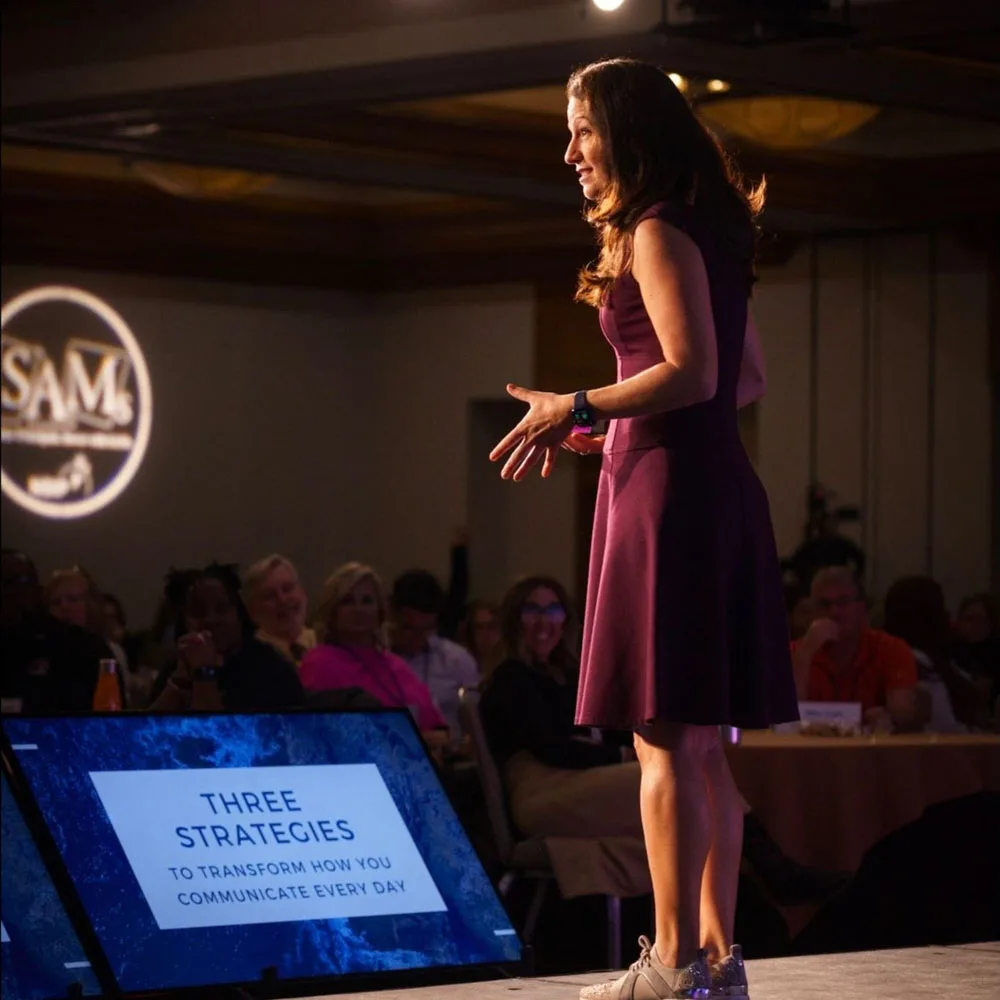
Audience attention is one of the most valuable assets a leader can earn—and one of the easiest to waste. The most impactful speakers create shared experiences that challenge assumptions, strengthen human connection, and inspire meaningful action. When leaders invest their time and attention in a conference or event, they deserve more than information transfer—they deserve an experience that generates momentum long after the keynote ends.
Recently, I took the Predictive Index assessment and learned that I am “off-the-charts” impatient. This will surprise very few people in my inner circle.
I am always looking for ways to maximize my time. As a keynote speaker, that includes maximizing my audience’s time as well. I want people to leave a speech feeling that their time was well spent and that they gained something meaningful from the experience.
One idea isn’t enough
A client will often tell me, “If the audience takes away one new idea from your keynote, I will consider it a success.”
That’s not enough.
People can listen to a podcast and take away one new idea. They can ask AI for one new idea.
Information is becoming abundant. Human connection is not.
A keynote should accomplish something more valuable. It should help people see the world differently. It should create an experience that challenges their assumptions and inspires them to action, for themselves or for their organizations.
In fact, the more abundant the information at our fingertips, the more valuable those shared human experiences become.
Human connection is the differentiator
As technology becomes more of an intermediary in how we work and live, conferences will become more valuable.
The real value of a conference is not the transfer of information. It is the opportunity to create shared experiences, challenge assumptions, build trust, and generate collective momentum.
The ability to create transformational experiences and human connection will become even more important in the years ahead — both from an economic and social perspective.
And that’s where my impatience kicks in.
The ROI of attention
My impatience frequently emerges when I am sitting in the audience listening to certain speakers. As I strain my eyes to read the slides, try to find the nuggets of value in an unstructured, wandering message, and listen to a speaker’s monotonous style, I find myself looking around the room and calculating the value of the audience’s attention.
What’s the cost of wasting the audience’s time?
Imagine 200 leaders gathered at a conference. Let’s say each leader generates at a minimum $500,000 of value for their organization every year. That represents $100 million worth of expertise sitting in those chairs.
Every hour of the audience’s time represents approximately $50,000 of productive capacity.
So how do you ensure a strong ROI from your speech or keynote?
The best speakers create excitement and momentum that people carry back into their work. They share actionable insights that you can’t read on a website, brochure, or AI-generated summary. For executives and industry leaders, these speakers help to humanize their organization by creating a shared experience that builds trust and strengthens relationships. Each of these components increases a leader’s ROI to the organization.
Why it matters
Yes, I’m impatient. But underneath that impatience is a deep respect for people’s time.
Time is one of the few things we can’t get back. When an audience gives us their attention, they are giving us something precious.
As speakers and leaders, our job is to honor that gift by making every moment as meaningful, useful, and human as possible.
Until next week,
~Allison
Make every speech better than the last
One way to honor an audience’s time is to treat every speech as an opportunity to improve.
After every keynote, I ask myself three questions:
- What worked?
- What didn’t?
- What will I do differently next time?
Then I immediately update my notes, outline, or script while the experience is still fresh.
In this short clip from my conversation with John Busby on the Builders podcast, I share the simple reflection process I use after every keynote and presentation to keep improving. →