
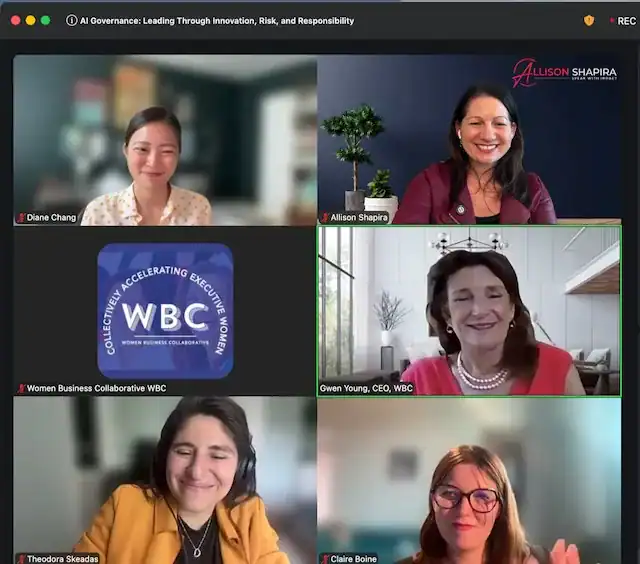
Communication is a governance tool. That was the central idea I shared during a recent Harvard Kennedy School panel on AI governance. While much of the conversation focused on regulation, risk, and oversight, my perspective centered on leadership communication. Organizations can create thoughtful AI policies, but those policies only succeed when leaders communicate the reasoning behind them in ways employees understand and trust.
Last week, I spoke on a webinar sponsored by the Harvard Kennedy School DC and NY alumni councils.
The topic was AI Governance: Leading Through Innovation, Risk and Responsibility. It was an all-female panel: Diane Chang, who leads Gemini enterprise trust and quality strategy at Google; Theodora Skeadas, Head of AI Red Teaming at Humane Intelligence; and Claire Boine, Assistant Professor in Technology Law and AI Governance at the European University Institute. Our moderator was Gwen Young of the HKS DC Alumni Council.
AI governance broadly refers to the rules and practices we put in place to guide how AI is developed and used. As I mention in my book AI for the Authentic Leader, it’s ironic that you need a permit to remodel your bathroom, but none to release a world-changing AI model into society (although that is starting to change).
For more than twenty years, I’ve advised senior leaders on how to communicate through change. My contribution to the panel focused on leading through the transformation AI is bringing to our organizations. As our workflow changes, our tools change, and our workforce adapts, leaders are called on to handle a change no one has prepared for at this scale.
Governance depends on communication
There are critical questions we have to answer, such as: Who owns an employee’s knowledge when they leave? If an agent learns from someone’s brilliant system, does the company then own the system? Issues of personal IP become critical to resolve.
With all these issues, the case I made was this: communication is a governance tool.
It’s not simply about deciding who gets access to these tools, how transparent AI companies are about training their models, or how your organization decides to use them. All of that matters, but none of it means anything if you can’t communicate the decision and the thinking behind it.
My entire career has focused on this concept: How you communicate is how you lead.
If your employees don’t understand the thought process behind the decision, or they mistrust the policy, or they disbelieve your words, then your governance falls flat.
How leaders build trust during AI change
For those of you making AI-focused decisions within your organization, keep in mind that communication is an interchange of ideas, not a one-way directive. The more people feel included in the decision-making process, the more they go along with the outcome.
So what can you do?
- Create Focus Groups or advisory councils made up of your key stakeholders. Ask for their opinions so that you can get a feeling for what’s happening on the ground within your organization.
- Solicit Different Voices, especially those who disagree with one another, so you can understand alternative perspectives.
- Share what you learn along the way, not just the final decision. Help people learn alongside you, which creates buy-in and increases cohesion.
For many of us, this is the first time in our lives we have the opportunity to write the rules by which we will be governed, as opposed to living by someone else’s rules.
After we built highways, society had to decide how much risk was an acceptable price for the mobility they gave us. We set speed limits, wrote traffic laws, and built a system that took decades to get right. This time, we don’t have decades. The technology is already in our hands, and we’re moving at breakneck speed.
The decisions we make in the next two years will affect the trajectory of human development. Let’s actively participate in this process so that everyone benefits from the super empowerment AI brings, and we minimize the risks to society.
I’m having these kinds of conversations in real time with leaders and their teams. Whether it’s a keynote on believability in the age of AI or one-on-one advisory as you shape your communication strategy, I’d love to help you think it through.
Send me an email to start a conversation.
Until next week,
~Allison
Communication is How You Lead
If communication is a governance tool, what makes communication effective?
I’ve spent more than two decades helping leaders communicate through change. Throughout that work, one principle has remained constant: how you communicate is how you lead.
In this conversation on The Tech Leader’s Playbook podcast with Avetis Antaplyan, I share the three qualities that make communication more effective, especially during times of rapid change: authenticity, clarity, and energy. Together, they form the foundation of my ACE Model of Leadership Communication.
Watch the clip →