
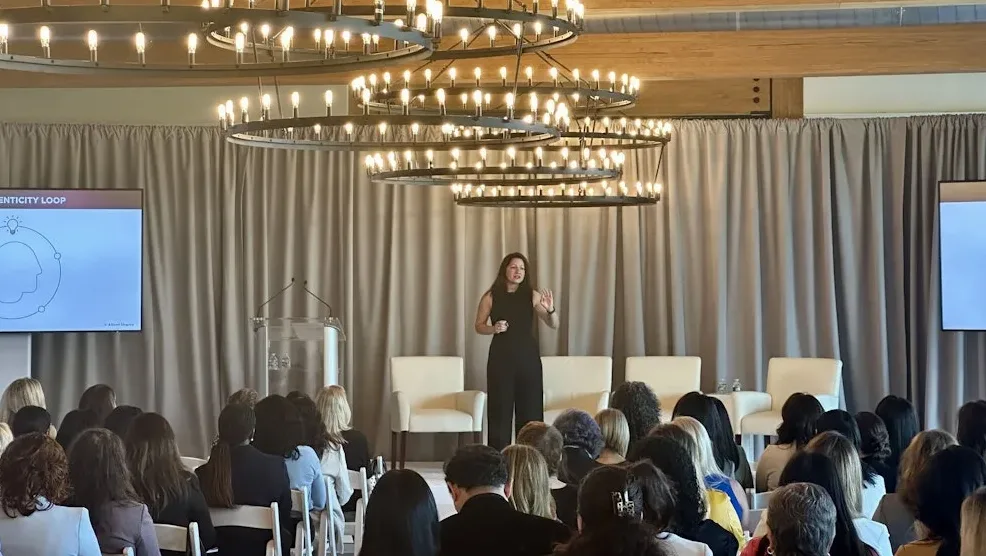
Using your phone for speaking notes may seem convenient, but it can undermine your effectiveness as a speaker. Whether you’re giving a wedding toast, presenting at a conference, or delivering a keynote, the way you manage your notes affects your eye contact, body language, and connection with the audience. A simple change in how you prepare your notes can help you speak with greater confidence and keep your audience engaged from beginning to end.
Your phone is sabotaging your speech
A friend of mine recently spoke at his brother’s wedding. He used my interview in Vogue Weddings, How to Write—and Deliver—the Perfect Wedding Speech to prepare.
He said, “I crushed it! The only problem was, I was using my phone for notes. So every time I waved my hand, it ‘undid’ what I had written down. And then the view flipped and I couldn’t see what I was saying.”
Using your phone for speaking notes is one of my biggest pet peeves. It doesn’t just happen in personal speeches, I saw it happen during a conference last week in Washington, DC.
I get it. Many of us don’t have printers at home or, certainly, on the road. But every hotel has a business center and, in 10 minutes, you can print out your speech.
Why Your Phone Gets in the Way
Here’s what’s wrong with using your phone:
- The text is tiny and hard to see, especially when you’re nervous
- You’re constantly looking down, which changes your body language and breaks your eye contact
- When the audience sees you on your phone, they’re reminded to look at their phones which makes them disengage
It’s funny how a device so small can create such a large barrier between you and your audience.
A Better Way to Use Notes
Here’s what to do instead:
- Print out your notes in bullet points in large font
- Use single-sided notes, so you don’t have to flip back and forth
- Put them in a plastic file folder like this ($10 for a pack of 24).
There is nothing wrong with using notes. In fact, I have notes nearby for nearly every speech or keynote. And memorizing the speech is a waste of time. Simply make sure you are intentional about your needs and the audience’s experience.
The goal isn’t to remember every word. The goal is to remain fully present with your audience. Whether you’re giving a keynote, leading a meeting, or having a difficult conversation, people trust leaders who are present.
Here is one of the most popular resources I share with my executive advisory clients: Guide to Using Notes Effectively
Until next week,
~Allison
A Final Thought on Preparation
One of the biggest misconceptions about public speaking is that confidence comes naturally to great speakers.
In my experience, confidence comes from having a process you trust.
When you know how to prepare, you spend less time overthinking and more time focusing on the people in front of you.
In this short video, I explain why structure creates freedom, and how a repeatable process can help you communicate with greater confidence and impact. →
