
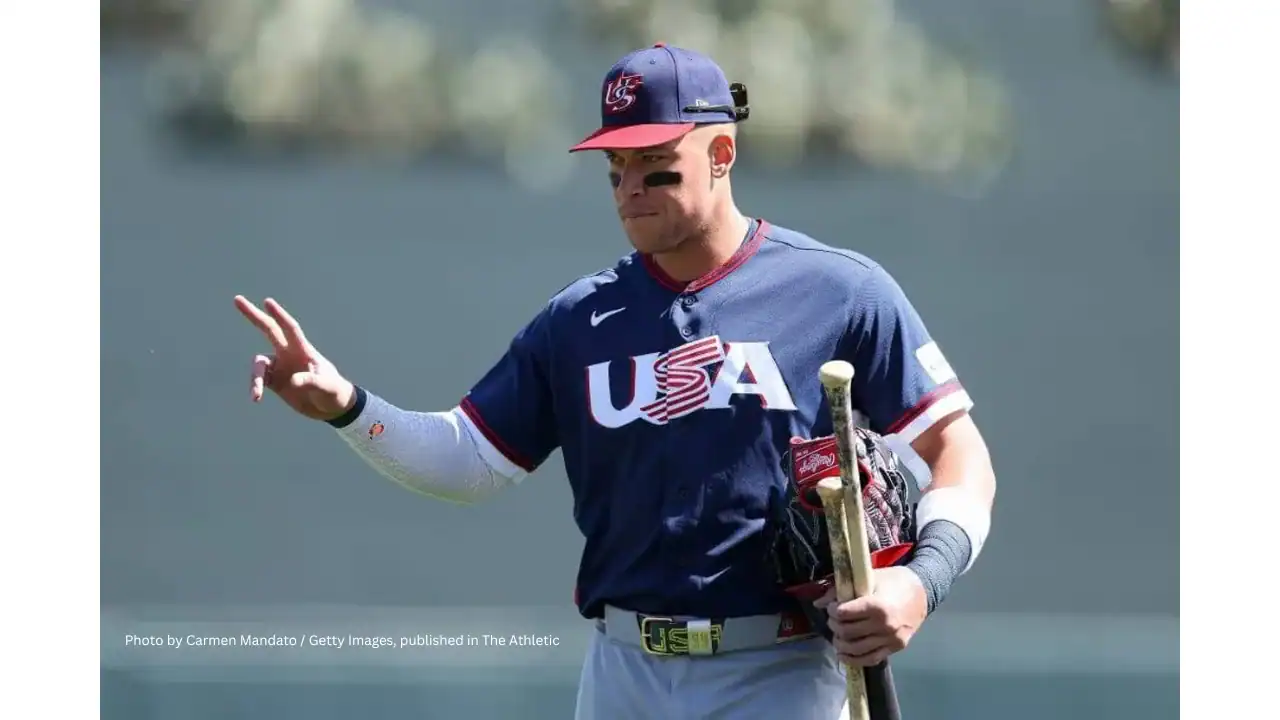
Leadership communication skills are often tested in moments leaders don’t expect. When someone steps into a leadership role—whether in business, sports, or public life—people immediately expect them to communicate with clarity, confidence, and purpose. Recently, a viral clip of New York Yankees outfielder Aaron Judge giving a speech to Team USA sparked a wave of online criticism. The reaction revealed something important about leadership: the moment someone is seen as a leader, people expect them to communicate like one.
Last week, something happened that reminded me why so many leaders fear public speaking.
Aaron Judge, the New York Yankees outfielder, gave a speech to Team USA before the World Baseball Classic. When MLB.com released a 20-second clip of the speech, the online response was immediate and harsh. Some called it “the worst speech ever.”
It wasn’t.
The New York Times called me to ask about the speech, just like they did when writing an article about Jimmy V’s famous ESPY speech last year.
What struck me most about the video clip was how quickly people judged the speech. A world-class athlete stepped into a role he hasn’t trained for his entire life—delivering an inspirational speech to a national team—and the internet evaluated him as if public speaking were supposed to come naturally.
The Internet Judges Fast
Most senior leaders built their credibility by being the trusted advisor—the one who was always prepared, always informed, always ready with a solution. That expertise earned them a seat at the table.
But at a certain level, expertise is no longer the basis for success.
You are now responsible for a broader portfolio. You’re pulled into board meetings, investor conversations, external panels, and internal town halls. You’re speaking more often, on topics that evolve daily, without additional time to prepare.
This reaction reveals something important about leadership.
Leadership Comes With a Communication Expectation
The moment someone is seen as a leader, people expect them to communicate like one.
In business, sports, and public life, we often assume that the person with the title will also be the person who can stand up, describe a shared vision, and motivate others to act. The expectation appears almost instantly, but the skill takes practice, discipline, and intention to develop.
That gap creates pressure for many leaders.
Public speaking is one of the most common fears in the world. A major reason is the fear of public judgment: the possibility that a single moment—captured on video and shared widely—could become a source of ridicule.
When we watch the reaction to a clip like this, we are watching that fear play out in real time.
At the same time, the expectation itself is not going away.
My definition of leadership is bringing people together to achieve a shared vision. Leaders must describe that vision in language that people understand and deliver it in a way that lifts it off the page and into the hearts and minds of the audience.
Leadership requires communication.
Others will evaluate your leadership, in part, by your ability to explain a direction, rally a team, and speak with clarity and confidence.
Communication Is a Leadership Skill—Not a Talent
Aaron Judge has spent his life training to hit a baseball. Very few people expect him to step onto the field and instantly perform at a world-class level in a different discipline.
Yet that is often what we expect of leaders when they speak.
The lesson for executives is clear: communication is not an accessory to leadership. It is one of the capabilities people look for when they decide whether to follow you.
And like any other leadership capability, it is a skill that we develop through practice, feedback, and time.
What are you doing to improve your communication as a leader?
If you’re looking to strengthen your leadership communication, let’s talk. Fill out our conversation form, and we’ll follow up within 24 hours.
Until next week,
~Allison
Practicing Your Public Speaking: 3 Questions for Constant Improvement
What does constant improvement look like for a professional speaker?
In this clip from my conversation with John Busby on the Builders Podcast, I share the three questions I ask after every presentation, how to solicit meaningful feedback, and how leaders can use reflection to become more effective communicators.
Watch the clip →