
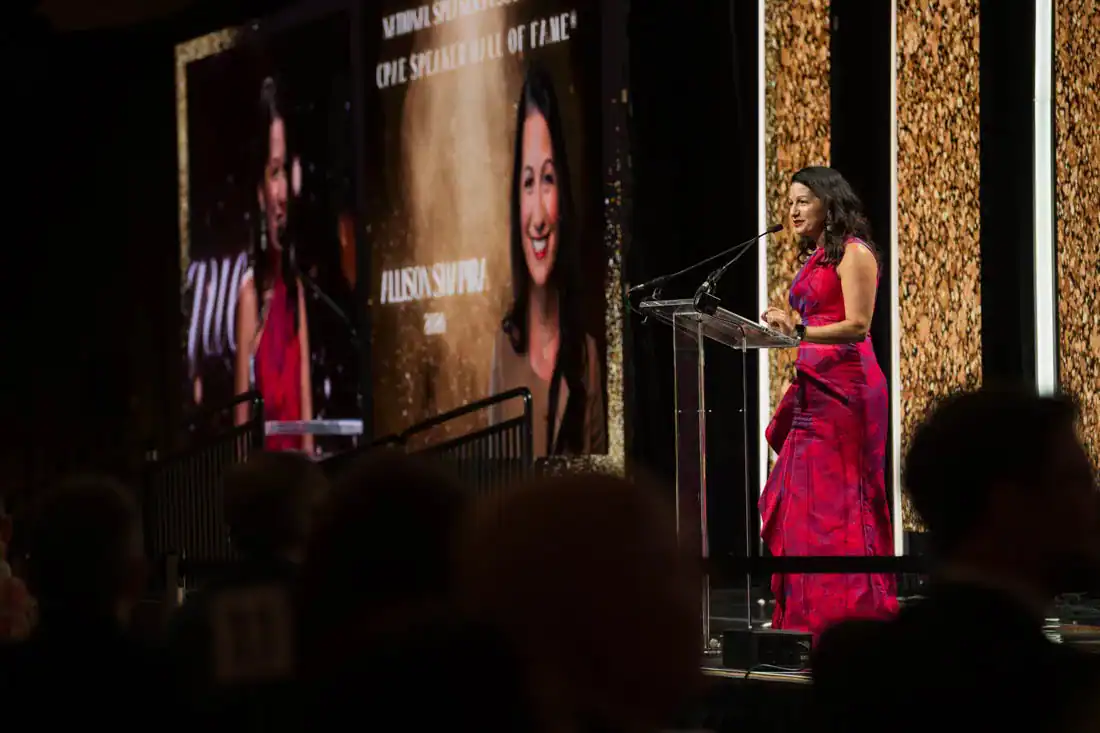
Recently, I had one of the greatest honors of my life: I was inducted into the CPAE Speaker Hall of Fame by the National Speakers Association.
The Council of Peers Award of Excellence (CPAE) is a lifetime achievement award recognizing the top 1% https://allisonshapira.com/cpae-hall-of-fame-recipient/of speakers worldwide. It honors speakers whose platforms have shaped entire fields, and includes past inductees such as Ronald Reagan, Colin Powell, and Zig Ziglar.
Writing the Speech
When you find out you’ve received an award, the initial excitement often turns into nervousness as you realize you have to write an acceptance speech—and in my case, deliver it in front of some of the best professional speakers in the world.
Should you start with gratitude?
The most frequently-asked question for this type of speech is: Should you start with gratitude? I always like to start a speech in an unexpected way, and starting with gratitude is what the audience expects. Unless you’re in a highly formalized setting where you need to begin with protocol, you can leave the “Thank You”s to the end. That’s what I did.
How many people should you thank?
Another question I hear is: how many people should I thank?
There are dozens of people who have helped me over the course of my speaking and coaching career, many of them there in the room. While the first draft of the speech thanked about 15 people, I soon realized it was taking up too much time and wouldn’t be as meaningful to everyone in the room. It felt like a “laundry list” – so I cut it and simply thanked my immediate family who were there in the room.
Asking the 3 Questions
Those of you who have worked with me over the years know that I always recommend you ask yourself 3 questions before a speech or presentation. That’s how I started my preparation.
1. Who is my audience?
This audience comprised both experienced professionals as well as newer speakers. My target audience was the first-timers, the newer speakers who didn’t know NSA and didn’t know the speaking profession.
2. What is my goal?
My goal was to show the journey, share stories that were relatable to my audience, and demonstrate that anyone in the room could make it onto that stage. My speech couldn’t be about how great I was – it had to be about how much I’ve learned from the people in that room.
3. Why me?
This question is the core of my methodology. It means “Why do I care? And when was a moment in my life that made me care?”
For an award like this, that answer was easy, and there were dozens of times in my life to choose from (in fact, when I woke up at 5am the day of the speech, it was all those stories from the cutting room floor that were going through my head).
Structure & Transitions
From there, it was time to think about structure. I wanted to include a series of vignettes from my life that showed the struggle and all those who had helped me. In order to do that effectively, I needed a series of transition phrases to weave them together, such as:
“You hear the word ‘no’ a lot in this business, and sometimes you have to say the word ‘no’ too.”
“Everyone in this room will give you their time, experience, and their heart. And I know a lot about heart, because I come from a family of healers, who are here in this room tonight.”
Using those transitions, I was able to weave together a momentum-building series of stories that took the audience on a journey through my life.
Bullet Points or Script?
Clients often ask me what to bring on stage with them.
This speech had a strict 6-minute deadline, and I had never given it before. I scripted it out and then reduced the final speech to bullet points, which I brought to the event.
Pro Tip: I gave my notes to the person introducing me, so I wouldn’t have to hold them while taking photos with the award. After we paused for photos, he handed me the sheet of paper, and I walked to the lectern.
Pause & Breathe
The most important moment of the evening started before I even spoke.
I stood in front of 800 friends and colleagues, many of whom I’ve known for over a decade (and a few I’ve known my entire life), and I did what I tell each and every one of you to do:
Pause & breathe.
I soaked in the moment, felt the love in the room, and remembered I was in service to others.
You are Part of This Award
If you’re reading this email, you’ve likely worked with me over the years: whether in a keynote, executive workshop, or executive coaching. You are part of this award.
Every client, colleague, and friend who trusted me to help them build their confidence and find their voice contributed to the body of work this recognizes.
I hope you have the joy of being honored one day by your peers. When you do, keep these strategies handy so you can honor hard work and pay homage to your field.
Congratulations to my fellow inductees: Peter Katz, Manley Feinberg, Jess Pettit, and Anton Gunn. And congratulations to our Cavett Award winner, Shep Hyken.
Resources
- To see photos from the evening, click here.
- Stay tuned for a video of the speech, which is still being edited.
- Here are the bullet points I brought up with me (one page!)
Thank you for being part of this journey.
I’m grateful to everyone who has trusted me over the years—clients, colleagues, friends, and fellow speakers. This recognition reflects the work we’ve done together, and I’m excited for what’s next.
~Allison
P.S. My new keynote, The Believability Gap: Why Leaders Lose Trust, is the culmination of my work and builds on my latest research on the science of believability: in an age where words are easier than ever to produce and harder than ever to trust, what makes people believe you?
To invite me to speak to your organization or work with your team, fill out our contact form. We’ll follow up within 24 hours to set up a conversation.